Since the last time I wrote in this blog over two years ago, I was looking forward to a new growing season in Tokyo starting in the spring. However on March 11 Japan was hit by the largest earthquake in modern times and a tsunami 30 meters high. This did not happen near Tokyo, but the effect shook the whole country.
Worse, and the reason I haven't written anything, is that soon after the earthquake the Fukushima nuclear reactors failed in the worst nuclear incident since Chernobyl. The land immediately around the reactor is irradiated and will be unusable for production for the next several hundred years. The dust plume caused by the Fukushima explosion spewed radioactive material, cesium mostly, into the atmosphere and that material settled throughout the eastern Japan area. Tokyo was also dusted with this material.
So instead of starting up a new crop in the spring of 2011, I sent my family to Seattle for several months to wait out the initial dust plume and I refrained from planting anything that could be contaminated by the radioactive fallout.
The dust has settled, and the concern about radioactivity in the Tokyo area has also settled. Two years later, it's time to restart.
Showing posts with label garden. Show all posts
Showing posts with label garden. Show all posts
Sunday, March 24, 2013


Sunday, August 1, 2010
New Garden: Seattle
Seattle presents great challenges for veranda gardening. Especially in my particular case where I have a giant tree blocking a lot of sunlight in the mornings. Also, although the days last from 6:00am until 9:30pm during the summers here, it never really warms up and the light itself is not very bright. There is a lot of fog in the mornings, so mold is almost guaranteed. The lack of sun means a lot of popular vegetables will be unproductive. The cold means slower growth and later, shorter growing periods.

This is the view from the veranda. You can see the tree that is blocking my sun. Just a few meters over, there is a lot of sun, but that area gets mowed frequently so I can't use it.
Forgetting all that, I went out and bought some supplies and transplants.

I bought a nice, deep planter. On the right is a big bag of Miracle-Gro soil which claims to fertilize plants for 6 months. Inside the planter are three plants I've selected for this year's garden: Japanese Cucumber, Japanese Eggplant, and Red Bell Peppers.
The problem is that these plants need full sun, but I can't offer that to them. Worst case, they will meet their doom in a week or so. Best case, I hope they can produce a few fruits.
There were a lot of pots already here, but I wanted a long, deep one so that I could effectively use the space on the porch. I can't believe it cost $17 at Home Depot. How can a plastic planter be so expensive?
Seattle also has a slug problem. They seek out gardens and munch. I considered lettuce, but I've seen how much slugs like it, so I decided against it. In order to help prevent slugs, I used bricks to raise the planter off the ground. You can see it in the final picture.
Cucumbers need to grow upwards, but garden netting is extremely expensive here. One net was going for $15 a square yard. There is something really uncomfortable about paying that much for disposable materials.


I'm a bit proud of the cucumbers on the left. In lieu of paying an arm and a leg for garden netting, I built my own. The materials used are a thumbtack, twine, and staples. The thumbtack (not pictured) holds the twine to the wall. The twine is stapled to the pot, and each of those "steps" is a piece of twine stapled to the vertical twine. Home-made and probably costing less than a penny.
Things are started!
Garden Round Up: Tokyo
Vegetable gardens, when productive, can be extremely productive. Some people are so overflowing with green peppers and squash and zucchinis that they can't give them away fast enough. When they are non-productive, you'll sit there nursing your one and only vegetable only to have it stop growing at half size and fall off the plant before you ever had a chance to eat it.
This year I had a lot of success with strawberries, potatoes, and tomatoes. On the other end of the spectrum, my green peppers and watermelon were merely decorative. I also had a few unexpected plants show up, like the new avocado tree. If I needed to survive on only my plants, I would not have made it.
However, I learned a few things.
- The pepper prefers to be closer to the veranda wall where there is more morning sun. Although the afternoon sun is longer, it is dimmer and less direct than the morning sun.
- I need to teach people taking care of my tomatoes *how* to remove the "waki me". I had a very productive year, but because one branch grew out of the side, I spent a lot of time trying to find ways to prop it up. I should have been spending that time eating more tomatoes.
- Watermelons need to be started earlier. If left to their own devices, they will sprout a month too late and won't reach maturity in time to harvest. Also, they probably need better soil and more room to grow.
- Strawberry plants die. I didn't think about this until just this summer when all the plants that bore fruit this spring dried up and died. The one that didn't produce any fruits at all is thriving and is currently sending out runners. I'll catch these and start again next year. I may try a different pot and retire the one I'm using now.
- Potatoes need more time. I probably harvested them too early. They were small, but they were tasty! Next year I'll wait a little longer before pulling them up.
The garden in Japan is still producing tomatoes and everyone over there is enjoying them. I had a couple before I left and thought they were a bit tough and sour. I bet if I waited just a couple days longer they would have tasted much better.
That's it for this year. I'll be heading back in December, so the next time I write about it, I'll be deciding what to plant in the winter. I'm thinking of a few things, but it'll take a little more research to do it right. More than anything else, I've found that planning and research leads to better results than seat-of-the-pants gardening. Planting is fun, but harvesting is better.
Sunday, July 11, 2010
Avocado: An interesting surprise
What really gets me about avocados is how fast they grow once they start. You can plant them or stick them in water and they do nothing for a long time. Sometimes they even start getting moldy and you consider throwing them out. Then one day it sprouts. And the next day it's grown an inch. In a week, you've got yourself a little tree.
That's what happened this morning in the veranda garden with a seed that I had all but forgotten.
Last January or so I took my son out to the garden to plant an avocado. It would be his own little seed and, eventually, tree. Sure we watered it, because it was planted with the bougainvillea so it got whatever water was left over. But for months nothing happened.
Then while I was moving some plants around to protect them from the wind this morning, I noticed a little stem sticking up from the soil. It's a new avocado tree!
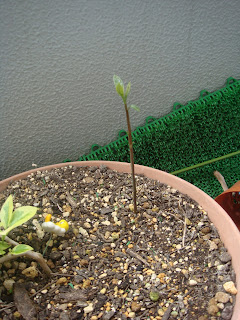
If I don't transplant it, I'm sure it will kill the other plant and the shallow pot may not be the right thing for it.
I'm busy this weekend, but maybe next weekend I'll pick out a nice pot for it.
That's what happened this morning in the veranda garden with a seed that I had all but forgotten.
Last January or so I took my son out to the garden to plant an avocado. It would be his own little seed and, eventually, tree. Sure we watered it, because it was planted with the bougainvillea so it got whatever water was left over. But for months nothing happened.
Then while I was moving some plants around to protect them from the wind this morning, I noticed a little stem sticking up from the soil. It's a new avocado tree!

If I don't transplant it, I'm sure it will kill the other plant and the shallow pot may not be the right thing for it.
I'm busy this weekend, but maybe next weekend I'll pick out a nice pot for it.
Tuesday, July 6, 2010
Tomato: Leaf malady
I'm not sure whether to water the tomato or if I'm watering it too much. The leaves are all droopy and it is looking listless. The outside temperature is 25°C and humidity is through the roof. Tomatoes like warm, dry temperatures, so this humidity may be pretty uncomfortable for it.
But the problem I'm most worried about is a white powder on the leaves. It looks like a fungus, but I can't find anything relevant online about it.

If anyone has any idea what the problem is and what the solution should be, please leave a comment.
But the problem I'm most worried about is a white powder on the leaves. It looks like a fungus, but I can't find anything relevant online about it.

If anyone has any idea what the problem is and what the solution should be, please leave a comment.
Monday, July 5, 2010
Green peppers: First pepper of the year
The green pepper plant has finally produced its first pepper. Unfortunately it looks a bit misshapen and probably will be the last pepper this plant ever makes.

This plant has been around more than a year now. It has survived the last winter. It has survived multiple aphid and fruit fly infestations. It probably won't survive much longer, though.
After this season, I'm planning on pulling it out and using the planter for something else. I haven't decide what yet, but the lack of production with this pepper has been disappointing.

This plant has been around more than a year now. It has survived the last winter. It has survived multiple aphid and fruit fly infestations. It probably won't survive much longer, though.
After this season, I'm planning on pulling it out and using the planter for something else. I haven't decide what yet, but the lack of production with this pepper has been disappointing.
Sunday, July 4, 2010
Tomato: Replacing the stake
The tomato plant has gone through extensive growth in the last few weeks. The original stake it was tied to has become just a bit too short for it.

By the way, this is what I look like at 6:30 in the morning.
As I mentioned in an earlier post, the tomato has branched, so replacing the stake is a two-pronged approach (I'm killing me with these puns). Here is the tomato before the stake replacement.

Here, you can see how the tomato branches to the left. There is a second stake to hold up the branch on the left. Actually, the branch on the left is the main branch! The branch that grows straight upwards grew out of a bud (わき芽). As I mentioned before, this is bad for the fruits because it draws nutrients away from the fruits and towards leaf growth.
At this point, though, removing the branch would cause a lot more trouble for the plant because it has given almost half of its energy growing that side. It is very large and has a couple sets of flowers. However, it is a subordinate branch, so I don't want to treat it like the primary branch.
I made two changes to the staking. The first is the primary stake. As you can see in the picture, it is much thicker and taller. This should help with strong winds as well as for future upwards growth.

The other change was to move the primary branch to the main stake. This is a bit difficult because the original staking had trained the primary branch to grow sideways. However, a bit of creative tying coaxed it into place. I also posted the smaller stake diagonally to support the branch.
Some leaves were removed in the process and mulched. The overall look is a bit cleaner and the tomatoes are now visible along the main branch. I'll be watching the side branch to make sure it has enough support since it is no longer held straight up and is only supported by one small stake.
To remedy this, I went to the home center and bought a brand new stake. It's taller than I am, so I don't expect any problems with size for the time being.

By the way, this is what I look like at 6:30 in the morning.
As I mentioned in an earlier post, the tomato has branched, so replacing the stake is a two-pronged approach (I'm killing me with these puns). Here is the tomato before the stake replacement.

Here, you can see how the tomato branches to the left. There is a second stake to hold up the branch on the left. Actually, the branch on the left is the main branch! The branch that grows straight upwards grew out of a bud (わき芽). As I mentioned before, this is bad for the fruits because it draws nutrients away from the fruits and towards leaf growth.
At this point, though, removing the branch would cause a lot more trouble for the plant because it has given almost half of its energy growing that side. It is very large and has a couple sets of flowers. However, it is a subordinate branch, so I don't want to treat it like the primary branch.
I made two changes to the staking. The first is the primary stake. As you can see in the picture, it is much thicker and taller. This should help with strong winds as well as for future upwards growth.

The other change was to move the primary branch to the main stake. This is a bit difficult because the original staking had trained the primary branch to grow sideways. However, a bit of creative tying coaxed it into place. I also posted the smaller stake diagonally to support the branch.
Some leaves were removed in the process and mulched. The overall look is a bit cleaner and the tomatoes are now visible along the main branch. I'll be watching the side branch to make sure it has enough support since it is no longer held straight up and is only supported by one small stake.
Thursday, July 1, 2010
Veranda: An overview
Yesterday an old friend asked what the whole garden looks like. I've been sharing pictures of individual plants, but not pictures of the garden in its entirety. The reason for that, mainly, is that the garden is terribly small and cluttered. It shares its space with the clotheslines, air conditioners, fire escape, and storage bin. On any typical day, it is a complete mess.
But I'll oblige! Standing in front of the storage box, here is a sweep from left to right.


This gets us to about the middle of the veranda. You can see the old potato planter with a watermelon growing, the peppers, tomatoes, a jade plant, the mulching pit with a circular support post falling over, and a few bags of recyclables that need to be thrown out next Wednesday.
Continuing on...


On this side of the veranda, you can see a small bougainvillea, an old (5 years?) gerbera plant, the strawberry planter, and the broccoli. There's also a bunch of clutter and clotheslines all over the place. My wife will probably be a little upset that these pictures are being posted...
One thing I don't want to neglect to mention is the fake grass on the floor. It was originally just a plain patio, but by using the fake grass the temperature is reduced and there is a slightly raised space between the plants and the floor. Water can flow out of the bottom of the pots to the floor underneath. Its job is to keep the veranda clean and dry, even after watering.
Behind the air conditioners on each side are avocados. Last year they looked really sick, but they have rebounded and now look really great. I think moving them to this small area has given them a bit more access to sunlight and the wind is subdued by the close walls.


That's what the veranda garden looks like. It isn't much, but I am making due with the small area I have.
But I'll oblige! Standing in front of the storage box, here is a sweep from left to right.


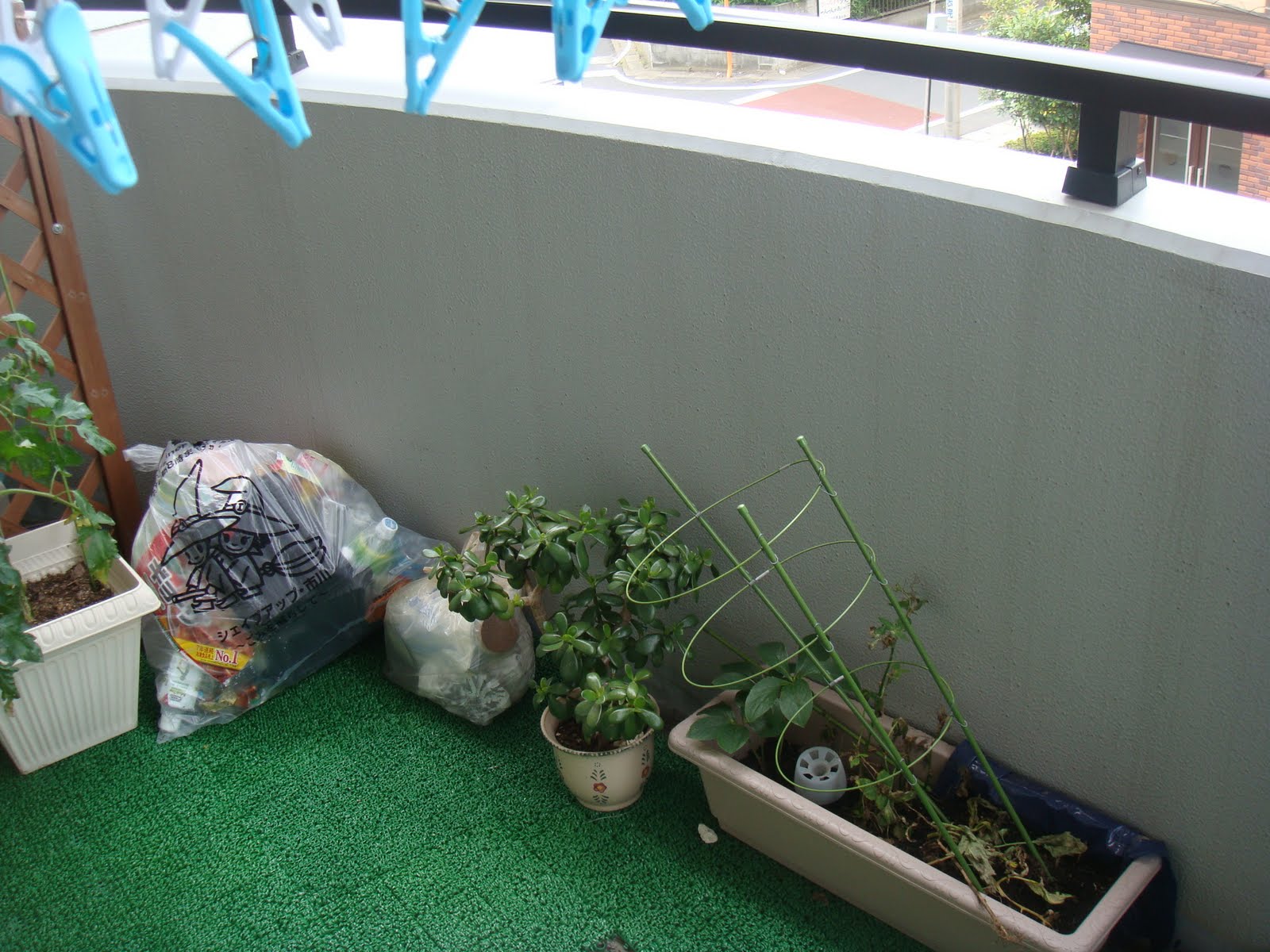

This gets us to about the middle of the veranda. You can see the old potato planter with a watermelon growing, the peppers, tomatoes, a jade plant, the mulching pit with a circular support post falling over, and a few bags of recyclables that need to be thrown out next Wednesday.
Continuing on...
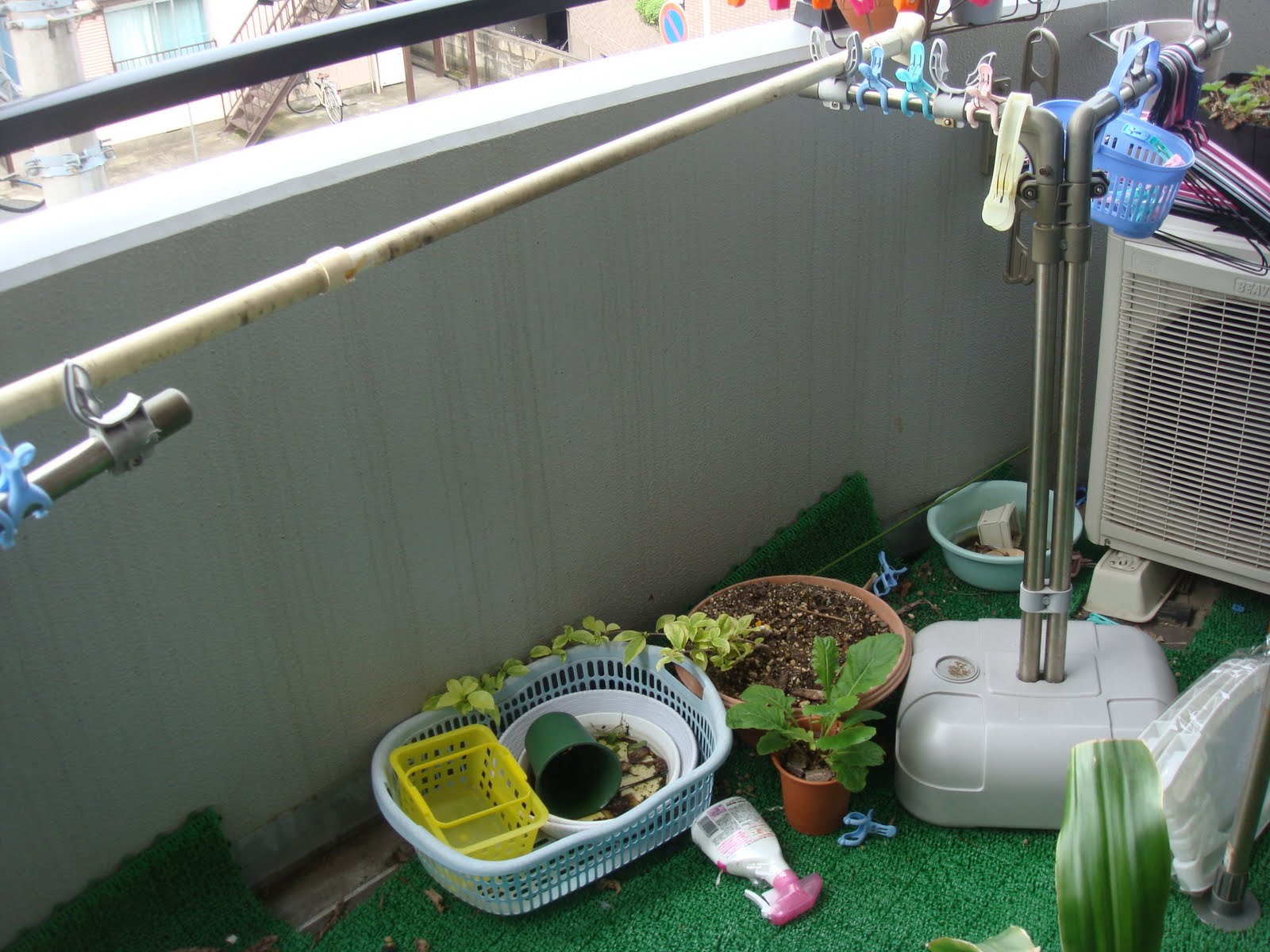

On this side of the veranda, you can see a small bougainvillea, an old (5 years?) gerbera plant, the strawberry planter, and the broccoli. There's also a bunch of clutter and clotheslines all over the place. My wife will probably be a little upset that these pictures are being posted...
One thing I don't want to neglect to mention is the fake grass on the floor. It was originally just a plain patio, but by using the fake grass the temperature is reduced and there is a slightly raised space between the plants and the floor. Water can flow out of the bottom of the pots to the floor underneath. Its job is to keep the veranda clean and dry, even after watering.
Behind the air conditioners on each side are avocados. Last year they looked really sick, but they have rebounded and now look really great. I think moving them to this small area has given them a bit more access to sunlight and the wind is subdued by the close walls.

The oldest.

The younger two.
That's what the veranda garden looks like. It isn't much, but I am making due with the small area I have.
Wednesday, June 30, 2010
Green peppers: Resurrection
Last year I bought two pepper plants. One was an expensive Del Monte red bell pepper from the home center and the other was a cheap green pepper from a farmers market. Neither one had any significant fruit, and the end of the season last year left both quite dry and dead.
The red bell pepper turned into a twig and withered away. I removed it from the soil several months ago. However the green pepper has had a resurgence and is putting out leaves like crazy. There is even a hint of flowering buds on some of the branches.
One problem is that the plant is pushing out from the old woody stem, so it does not have a lot of growth upwards. Usually a pepper plant will grow around 50-80cm in height, but this one is bushy and only around 20-30cm. Some pruning may help a bit, but the direction of growth is clearly sideways not upwards.
I've read that pruning the first flowering buds can help improve fruiting by delaying the onset of fruits until the plant grows larger. If these flowers become peppers, I may snip them off a little early to encourage further fruiting growth.

One issue that I'm taking a look at is aphid infestation. This plant seems, more than any other plant in the garden, is riddled with the little bugs. You can see some of the various bugs in this picture. An obvious one is the little white dot on the leaf. I've used some pesticide on it, but the aphids keep coming back. I've heard that taking masking tape to the leaves can help physically remove these bugs.
For now, the bugs are being treated chemically. I suppose it isn't very organic, but it is a lot less messy.
The red bell pepper turned into a twig and withered away. I removed it from the soil several months ago. However the green pepper has had a resurgence and is putting out leaves like crazy. There is even a hint of flowering buds on some of the branches.
One problem is that the plant is pushing out from the old woody stem, so it does not have a lot of growth upwards. Usually a pepper plant will grow around 50-80cm in height, but this one is bushy and only around 20-30cm. Some pruning may help a bit, but the direction of growth is clearly sideways not upwards.
I've read that pruning the first flowering buds can help improve fruiting by delaying the onset of fruits until the plant grows larger. If these flowers become peppers, I may snip them off a little early to encourage further fruiting growth.

One issue that I'm taking a look at is aphid infestation. This plant seems, more than any other plant in the garden, is riddled with the little bugs. You can see some of the various bugs in this picture. An obvious one is the little white dot on the leaf. I've used some pesticide on it, but the aphids keep coming back. I've heard that taking masking tape to the leaves can help physically remove these bugs.
For now, the bugs are being treated chemically. I suppose it isn't very organic, but it is a lot less messy.
Tuesday, June 29, 2010
Tomato: Summer has arrived
It's hard to believe, but the little tomato seed I planted back in March has grown into a great big tomato plant and it is starting to bear fruit.
I left Tokyo for a 3 week trip to Seattle and when I left the plant was barely 15cm tall. I came back on Monday and found the plant had grown to over a meter. In fact, if it weren't for branching, the plant would no doubt be even taller.

One of the care tips for growing tomatoes is to remove buds that appear in between the main stem and the leaf branches. Leaving them in will result in the stem splitting into two branches. This can result in a bigger, bushier plant, but the downside is that each branch must then compete for nutrients and that can result in a lower yield.
Unfortunately while I was out in Seattle, one bud turned into a branch and is now flowering. Cutting it at this stage would probably harm the plant, so I will leave it on and hope for the best. If you catch the buds when they are small, you can remove them fairly easily with just a pinch. When they are larger, though, they require scissors or shears to remove. It also exposes a large raw area which can become infected, so it's better to nip it in the bud (get it? aren't I clever?) than to wait until you've got two branches.
Of course, all this gardening and care talk is just filler for the real reason for this post (as well as the reason we are growing them): Tomatoes!

There are at least two bunches of tomatoes growing now. The tomatoes shown here are about the size of normal cherry tomatoes. These are medium-sized tomatoes, so they should grow quite a bit bigger and redder.
Sunday, May 30, 2010
Potato: A quick peek
In the spring time, Japan experiences very strong wind storms as the weather warms up. This year, the wind whipped through the veranda and caused a lot of damage. Our laundry rack was blown over and the leaves were torn off of some of the plants. One potato plant took a huge amount of damage, losing all of its leaves. That plant has died.
 There are three potatoes visible in this picture. The largest and most visible one is about the size of a golf ball. The smallest one is about the size of a marble. There is about one month more to go before harvest time, but these potatoes are coming along very well.

But the other potato seems to be going strong. The leaves are broken in places, but the stem is still strong and the remaining leaves haven't wilted yet.
I was curious about the status of the potatoes under the soil. It's all kind of mysterious. How deep are the potatoes? What do they look like? So I scraped away at the soil to find the hidden treasure.
 There are three potatoes visible in this picture. The largest and most visible one is about the size of a golf ball. The smallest one is about the size of a marble. There is about one month more to go before harvest time, but these potatoes are coming along very well.
In order to prevent solanine contamination, I quickly covered the potatoes back up and tamped the soil back down.
A brief update about the tomatoes. There has been a lot of growth in the past week. The re-potted tomato has grown significantly, especially compared with the seedlings still in the starter tray. More space for root growth as well as more fertilizer has probably led to this. I've tied the stem to the post, but at the speed it is growing, I'll have to make another tie soon.

I took the remaining seedlings in the starter pots, save two, and added them to the compost bin. The two that are saved may go to a loving family who doesn't mind that the growing season is already well underway.
Watermelons everywhere!
I mentioned previously that I had found a watermelon sprout near the peppers. Well, more have popped up.
Apparently the perfect weather has arrived for these things because everywhere I look I'm finding watermelon sprouts. When I re-used the soil, I didn't expect that the seeds were still viable. At this late stage of spring (because it sure isn't summer here yet) I wonder if it's even worth it to keep these seedlings.
Thursday, May 20, 2010
Not everything needs to be edible
So while the garden I'm cultivating is mostly geared towards vegetables, I do have some plants that are just for aesthetics.
Garbera
This gerbera is one of the oldest plants I have in my garden actually. It was given to us as a gift about 7 years ago and has flowered every year. What's amazing is how hardy this plant is. It dries up and seems to die off every winter, but come spring there is a new set of leaves and by summer there are beautiful blooms.

While it is a great looking plant, I am also severely allergic to its pollen. So I can only admire it from afar.
This gerbera is one of the oldest plants I have in my garden actually. It was given to us as a gift about 7 years ago and has flowered every year. What's amazing is how hardy this plant is. It dries up and seems to die off every winter, but come spring there is a new set of leaves and by summer there are beautiful blooms.

While it is a great looking plant, I am also severely allergic to its pollen. So I can only admire it from afar.
Bougainvillea
Growing up on Guam gave me access to Bougainvillea all throughout my childhood. These trees can grow several meters in height if unchecked? They are also thorny and once you lose your soccer ball to one, it's never coming out.
Growing up on Guam gave me access to Bougainvillea all throughout my childhood. These trees can grow several meters in height if unchecked? They are also thorny and once you lose your soccer ball to one, it's never coming out.

This particular Bougainvillea is a purple miniature. Unfortunately due to insufficient sunlight it has not bloomed since the first year we bought it.
Bougainvillea are interesting because people often mistake the colorful leaves surrounding the flowers for the flowers themselves. Bougainvillea flowers are small and white and hide inside a group of colored leaves. These leaves are white, purple, red, or even orange. If you get a chance to see one, look carefully at the flower and you can see how the misunderstanding can be made.
Jade Plant
In Japanese this plant is called the "kane no naru ki" or "money tree". It is a type of succulent and is incredibly hardy. When the plant dries out, the leaves turn reddish. I've seen a plant return from the red state back to full, vigorous health.
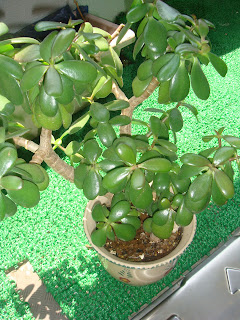
In some ways the vigor of this plant is a little too much. It seems that any part of it can be used as a cutting. When a leaf falls off into the soil, it invariably grows roots and starts a new plant. If you buy one of these at the home center, a jade plant will typically run between 100-200 yen. I can't believe I'm busy throwing these sprouts out at those prices.
Christmas Rose
Two years ago we bought this flower, and for two years it has not bloomed. Although called Christmas Rose, the plant is not particularly durable in the cold weather and it goes through death/regrowth cycles like the gerbera. Last autumn, I transplanted it into the same planter as the composting heap, and it seems to have benefited from the extra nutrients. I expect it to flower this year.

Watermelon: Probably pointless
Way back in March I planted some watermelon seeds. Watermelon is supposed to germinate and grow to transplantable size in about two months. I waited.
But after a couple months, not even a tiny root was found on any of the planted seeds. I called the whole thing off three weeks ago and mixed the used soil into the compost pile.
A strange thing happened. While I was transplanting the tomatoes, I used some of the composted soil and found a watermelon seed that had sprouted. It was really tiny and had obviously sprouted very recently. I dug that little guy out and popped him into another planter.
He's visible here in this picture. The seed shell is still wrapped around the two cotyledons (first leaves), but it has pushed its way out of the soil by about 3cm.

Watermelons require about 2.5 square meters of space to grow, but I'm going to try growing it upright so that it doesn't spread all over the ground. I saw a system that uses a mesh to hold up the plant and hanging nets to cradle the fruits.
Honestly, I don't have high hopes for a productive watermelon plant, but I'm looking forward to trying!
But after a couple months, not even a tiny root was found on any of the planted seeds. I called the whole thing off three weeks ago and mixed the used soil into the compost pile.
A strange thing happened. While I was transplanting the tomatoes, I used some of the composted soil and found a watermelon seed that had sprouted. It was really tiny and had obviously sprouted very recently. I dug that little guy out and popped him into another planter.
He's visible here in this picture. The seed shell is still wrapped around the two cotyledons (first leaves), but it has pushed its way out of the soil by about 3cm.

Watermelons require about 2.5 square meters of space to grow, but I'm going to try growing it upright so that it doesn't spread all over the ground. I saw a system that uses a mesh to hold up the plant and hanging nets to cradle the fruits.
Honestly, I don't have high hopes for a productive watermelon plant, but I'm looking forward to trying!
Wednesday, May 19, 2010
Potato: Wind damage
Living near the ocean, we get strong winds occasionally. Yesterday we had especially strong winds that ended up flinging laundry and futons all over the neighborhood. One futon ended up on the roof of the neighboring apartment. The laundry poles were torn down and many of the plants were toppled.
The potatoes, being in a wide and stable pot, did not tip over, but the wind took its toll. The leaves are a mess and some of the branches seem to have been torn off completely. Part of this is because the plant bumps up against the side of the planter and against other things nearby when the wind blows it. This seems to explain most of the damage.

The smaller plant took the brunt of the damage, and I'll have to keep an eye on it.
Fortunately, the larger plant did not take much damage. This is good because in the middle of the stem is what looks like the beginnings of a set of flowers. After 4 months, the potato is finally going to bloom.
The potatoes, being in a wide and stable pot, did not tip over, but the wind took its toll. The leaves are a mess and some of the branches seem to have been torn off completely. Part of this is because the plant bumps up against the side of the planter and against other things nearby when the wind blows it. This seems to explain most of the damage.

The smaller plant took the brunt of the damage, and I'll have to keep an eye on it.
Fortunately, the larger plant did not take much damage. This is good because in the middle of the stem is what looks like the beginnings of a set of flowers. After 4 months, the potato is finally going to bloom.
Monday, May 17, 2010
Broccoli: Gone to seed
The broccoli has been prolific in the amount of stalks it produced, but unfortunately the taste has been mediocre at best. Also, the timing required to harvest the stalks is incredibly precise; a day early and it is too "green" tasting and a day late means the florets bloom. I'm calling this little experiment complete and have let the plant go to seed.
Since I've stopped cutting the stalks, new florets have not grown very much. Most of the plant's energy seems to have become focused on putting out flowers. You can see what it looks like now in this photo taken this morning.

Broccoli is a member of the same family as cabbage. There is an apartment around the corner from me that has ornamental cabbages growing in the lobby. You can see the similarity between the flowers of the broccoli above and the cabbage below.

I'll bring the broccoli indoors soon and put some seed-catching paper around it to prepare for next year. I think I need better soil and probably better weather than we've had this year. This winter has been holding on too long.
Since I've stopped cutting the stalks, new florets have not grown very much. Most of the plant's energy seems to have become focused on putting out flowers. You can see what it looks like now in this photo taken this morning.

Broccoli is a member of the same family as cabbage. There is an apartment around the corner from me that has ornamental cabbages growing in the lobby. You can see the similarity between the flowers of the broccoli above and the cabbage below.

I'll bring the broccoli indoors soon and put some seed-catching paper around it to prepare for next year. I think I need better soil and probably better weather than we've had this year. This winter has been holding on too long.
Saturday, May 15, 2010
Tomato: Transplanting day
So what's it been? A couple weeks since I last wrote in earnest here?..
To be honest, a lot of gardening is just sitting around waiting for stuff to happen. There hasn't really been much of note to talk about, so I won't bother you with the minutiae of watering and moving planters around.
Today was actually a big day here. The tomatoes have reached transplanting age, and I spent a few minutes this morning transplanting the healthiest tomato into a large planter. There are actually a few healthy tomatoes, but I honestly don't have room for all of them. There is a nice family that lives down the block who always have such great tomato plants, I may drop one off on their doorstep in the middle of the night.
The transplant actually began a week ago. Before the actual plant is entered into the pot, I prepared the soil. First, I added a bunch of the "compost" from my makeshift compost pile. On top of that, I added some pelletized manure and some strawberry plant fertilizer (it is a balanced 7-7-7 blend). After mixing the soil thoroughly, I watered it and let it stand for a week. Today, the soil was loamy and crumbly, in other words just right.
I picked the tomato with the broadest, healthiest leaves and cut its little plastic pot away from the others. With the pot still intact, I dug a hole in the planter soil and placed the plastic pot directly in. Once the pot was in place, I packed extra soil around it and watered thoroughly.
The reason behind this step is that the hole for the transplant is the exact same size as the soil block going in. Once the soil was watered, I took the plastic pot out and it left a perfectly-sized hole. I tapped the tomato seedling out of the pot and slid it right into the hole.
After the tomato went in, I packed a little more soil around it and tamped it down.
I have also added a guide stick which I will tie the tomato plant to. I'm all out of twine at the moment. Maybe I'll have some time to pick some up tomorrow.
Here's what it looks like in the new planter.


If you have need of a tomato seedling, I've got a handful left! Please let me know.
To be honest, a lot of gardening is just sitting around waiting for stuff to happen. There hasn't really been much of note to talk about, so I won't bother you with the minutiae of watering and moving planters around.
Today was actually a big day here. The tomatoes have reached transplanting age, and I spent a few minutes this morning transplanting the healthiest tomato into a large planter. There are actually a few healthy tomatoes, but I honestly don't have room for all of them. There is a nice family that lives down the block who always have such great tomato plants, I may drop one off on their doorstep in the middle of the night.
The transplant actually began a week ago. Before the actual plant is entered into the pot, I prepared the soil. First, I added a bunch of the "compost" from my makeshift compost pile. On top of that, I added some pelletized manure and some strawberry plant fertilizer (it is a balanced 7-7-7 blend). After mixing the soil thoroughly, I watered it and let it stand for a week. Today, the soil was loamy and crumbly, in other words just right.
I picked the tomato with the broadest, healthiest leaves and cut its little plastic pot away from the others. With the pot still intact, I dug a hole in the planter soil and placed the plastic pot directly in. Once the pot was in place, I packed extra soil around it and watered thoroughly.
The reason behind this step is that the hole for the transplant is the exact same size as the soil block going in. Once the soil was watered, I took the plastic pot out and it left a perfectly-sized hole. I tapped the tomato seedling out of the pot and slid it right into the hole.
After the tomato went in, I packed a little more soil around it and tamped it down.
I have also added a guide stick which I will tie the tomato plant to. I'm all out of twine at the moment. Maybe I'll have some time to pick some up tomorrow.
Here's what it looks like in the new planter.


If you have need of a tomato seedling, I've got a handful left! Please let me know.
Friday, May 7, 2010
Earthworms in my mulch
I was preparing the planter which will take my tomato seedlings and as I was digging around in the mulching box I found tens of earthworms. *shiver*
What is strange is that there isn't any way they got here themselves. They must be laying dormant in some other medium. Fertilizer? Bagged soil? Polished rice husks? Other plants on the veranda?
They are here to help, and I appreciate that. But man do they get my heebies jeebing.
What is strange is that there isn't any way they got here themselves. They must be laying dormant in some other medium. Fertilizer? Bagged soil? Polished rice husks? Other plants on the veranda?
They are here to help, and I appreciate that. But man do they get my heebies jeebing.
Thursday, April 22, 2010
Strawberry: Crows
This morning a crow landed on the veranda and looked at my strawberry lustfully. I scared it away, but if it knows where the strawberries are, it will most likely come back.
Here's the biggest strawberry. It is looking really good. In a week or so it should be fully ripened and ready to eat.

I guess if the crow eats it, this picture will just be for posterity...
Where did I put that greenhouse?
Here's the biggest strawberry. It is looking really good. In a week or so it should be fully ripened and ready to eat.

I guess if the crow eats it, this picture will just be for posterity...
Where did I put that greenhouse?
Tomato: Seedlings coming along
The weather has again taken a turn for the worse and so I'm worried about the young tomato seedlings. The past couple days have been really warm and sunny, and the seedlings perked up a lot. However, if the frost comes tomorrow morning, these little guys may be wiped out in one fell swoop.
I took the opportunity last weekend to thin some of the plants. Since each pot received 3 seeds, some pots needed thinning.
Unfortunately, the fluctuating weather has been tough on the seedlings, and a few pots are unpopulated. It's okay, though, I really didn't need 16 tomato plants growing all at once.

I had originally expected that the plants would be much bigger by now, actually. The seedlings at the home center are all at least 10cm tall, but mine are barely 2cm. But it is still early in the planting season and so these seedlings still have 3 more weeks before they need transplanting. If the weather holds up, they should be 10-20cm in a couple more weeks.
I took the opportunity last weekend to thin some of the plants. Since each pot received 3 seeds, some pots needed thinning.
Unfortunately, the fluctuating weather has been tough on the seedlings, and a few pots are unpopulated. It's okay, though, I really didn't need 16 tomato plants growing all at once.

I had originally expected that the plants would be much bigger by now, actually. The seedlings at the home center are all at least 10cm tall, but mine are barely 2cm. But it is still early in the planting season and so these seedlings still have 3 more weeks before they need transplanting. If the weather holds up, they should be 10-20cm in a couple more weeks.
Subscribe to:
Posts (Atom)