Wednesday, June 30, 2010

Green peppers: Resurrection

Last year I bought two pepper plants. One was an expensive Del Monte red bell pepper from the home center and the other was a cheap green pepper from a farmers market. Neither one had any significant fruit, and the end of the season last year left both quite dry and dead.

The red bell pepper turned into a twig and withered away. I removed it from the soil several months ago. However the green pepper has had a resurgence and is putting out leaves like crazy. There is even a hint of flowering buds on some of the branches.

One problem is that the plant is pushing out from the old woody stem, so it does not have a lot of growth upwards. Usually a pepper plant will grow around 50-80cm in height, but this one is bushy and only around 20-30cm. Some pruning may help a bit, but the direction of growth is clearly sideways not upwards.

I've read that pruning the first flowering buds can help improve fruiting by delaying the onset of fruits until the plant grows larger. If these flowers become peppers, I may snip them off a little early to encourage further fruiting growth.

One issue that I'm taking a look at is aphid infestation. This plant seems, more than any other plant in the garden, is riddled with the little bugs. You can see some of the various bugs in this picture. An obvious one is the little white dot on the leaf. I've used some pesticide on it, but the aphids keep coming back. I've heard that taking masking tape to the leaves can help physically remove these bugs.

For now, the bugs are being treated chemically. I suppose it isn't very organic, but it is a lot less messy.

Tuesday, June 29, 2010

Tomato: Summer has arrived

It's hard to believe, but the little tomato seed I planted back in March has grown into a great big tomato plant and it is starting to bear fruit.

I left Tokyo for a 3 week trip to Seattle and when I left the plant was barely 15cm tall. I came back on Monday and found the plant had grown to over a meter. In fact, if it weren't for branching, the plant would no doubt be even taller.


One of the care tips for growing tomatoes is to remove buds that appear in between the main stem and the leaf branches. Leaving them in will result in the stem splitting into two branches. This can result in a bigger, bushier plant, but the downside is that each branch must then compete for nutrients and that can result in a lower yield.

Unfortunately while I was out in Seattle, one bud turned into a branch and is now flowering. Cutting it at this stage would probably harm the plant, so I will leave it on and hope for the best. If you catch the buds when they are small, you can remove them fairly easily with just a pinch. When they are larger, though, they require scissors or shears to remove. It also exposes a large raw area which can become infected, so it's better to nip it in the bud (get it? aren't I clever?) than to wait until you've got two branches.

Of course, all this gardening and care talk is just filler for the real reason for this post (as well as the reason we are growing them): Tomatoes!


There are at least two bunches of tomatoes growing now. The tomatoes shown here are about the size of normal cherry tomatoes. These are medium-sized tomatoes, so they should grow quite a bit bigger and redder.

Tuesday, June 8, 2010

A short break

I'm out of the country for a few weeks, so there won't be any updates to this blog for a while.

The potatoes were delicious.

Sunday, May 30, 2010

Potato: A quick peek

In the spring time, Japan experiences very strong wind storms as the weather warms up. This year, the wind whipped through the veranda and caused a lot of damage. Our laundry rack was blown over and the leaves were torn off of some of the plants. One potato plant took a huge amount of damage, losing all of its leaves. That plant has died.

But the other potato seems to be going strong. The leaves are broken in places, but the stem is still strong and the remaining leaves haven't wilted yet.

I was curious about the status of the potatoes under the soil. It's all kind of mysterious. How deep are the potatoes? What do they look like? So I scraped away at the soil to find the hidden treasure.

There are three potatoes visible in this picture. The largest and most visible one is about the size of a golf ball. The smallest one is about the size of a marble. There is about one month more to go before harvest time, but these potatoes are coming along very well.

In order to prevent solanine contamination, I quickly covered the potatoes back up and tamped the soil back down.

A brief update about the tomatoes. There has been a lot of growth in the past week. The re-potted tomato has grown significantly, especially compared with the seedlings still in the starter tray. More space for root growth as well as more fertilizer has probably led to this. I've tied the stem to the post, but at the speed it is growing, I'll have to make another tie soon.
I took the remaining seedlings in the starter pots, save two, and added them to the compost bin. The two that are saved may go to a loving family who doesn't mind that the growing season is already well underway.

Watermelons everywhere!

I mentioned previously that I had found a watermelon sprout near the peppers. Well, more have popped up.

Apparently the perfect weather has arrived for these things because everywhere I look I'm finding watermelon sprouts. When I re-used the soil, I didn't expect that the seeds were still viable. At this late stage of spring (because it sure isn't summer here yet) I wonder if it's even worth it to keep these seedlings.

Thursday, May 20, 2010

Not everything needs to be edible

So while the garden I'm cultivating is mostly geared towards vegetables, I do have some plants that are just for aesthetics.

Garbera
This gerbera is one of the oldest plants I have in my garden actually. It was given to us as a gift about 7 years ago and has flowered every year. What's amazing is how hardy this plant is. It dries up and seems to die off every winter, but come spring there is a new set of leaves and by summer there are beautiful blooms.

While it is a great looking plant, I am also severely allergic to its pollen. So I can only admire it from afar.

Bougainvillea
Growing up on Guam gave me access to Bougainvillea all throughout my childhood. These trees can grow several meters in height if unchecked? They are also thorny and once you lose your soccer ball to one, it's never coming out.
This particular Bougainvillea is a purple miniature. Unfortunately due to insufficient sunlight it has not bloomed since the first year we bought it.

Bougainvillea are interesting because people often mistake the colorful leaves surrounding the flowers for the flowers themselves. Bougainvillea flowers are small and white and hide inside a group of colored leaves. These leaves are white, purple, red, or even orange. If you get a chance to see one, look carefully at the flower and you can see how the misunderstanding can be made.

Jade Plant
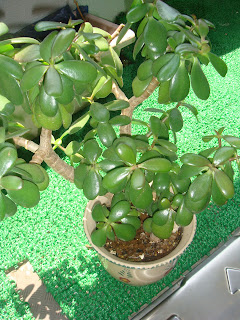
In Japanese this plant is called the "kane no naru ki" or "money tree". It is a type of succulent and is incredibly hardy. When the plant dries out, the leaves turn reddish. I've seen a plant return from the red state back to full, vigorous health.
In some ways the vigor of this plant is a little too much. It seems that any part of it can be used as a cutting. When a leaf falls off into the soil, it invariably grows roots and starts a new plant. If you buy one of these at the home center, a jade plant will typically run between 100-200 yen. I can't believe I'm busy throwing these sprouts out at those prices.

Christmas Rose
Two years ago we bought this flower, and for two years it has not bloomed. Although called Christmas Rose, the plant is not particularly durable in the cold weather and it goes through death/regrowth cycles like the gerbera. Last autumn, I transplanted it into the same planter as the composting heap, and it seems to have benefited from the extra nutrients. I expect it to flower this year.

Watermelon: Probably pointless

Way back in March I planted some watermelon seeds. Watermelon is supposed to germinate and grow to transplantable size in about two months. I waited.

But after a couple months, not even a tiny root was found on any of the planted seeds. I called the whole thing off three weeks ago and mixed the used soil into the compost pile.

A strange thing happened. While I was transplanting the tomatoes, I used some of the composted soil and found a watermelon seed that had sprouted. It was really tiny and had obviously sprouted very recently. I dug that little guy out and popped him into another planter.

He's visible here in this picture. The seed shell is still wrapped around the two cotyledons (first leaves), but it has pushed its way out of the soil by about 3cm.


Watermelons require about 2.5 square meters of space to grow, but I'm going to try growing it upright so that it doesn't spread all over the ground. I saw a system that uses a mesh to hold up the plant and hanging nets to cradle the fruits.

Honestly, I don't have high hopes for a productive watermelon plant, but I'm looking forward to trying!